Some linework challenges are not about strength or experience; they are about controlling small parts in high-consequence conditions. When a crew is moving hot jumpers, a simple washer or nut can become the part that slows the job, interrupts the workflow, or increases the amount of time a lineman must spend in an exposed position. That is the problem DDIN’s Tri-Clamp was built to address.
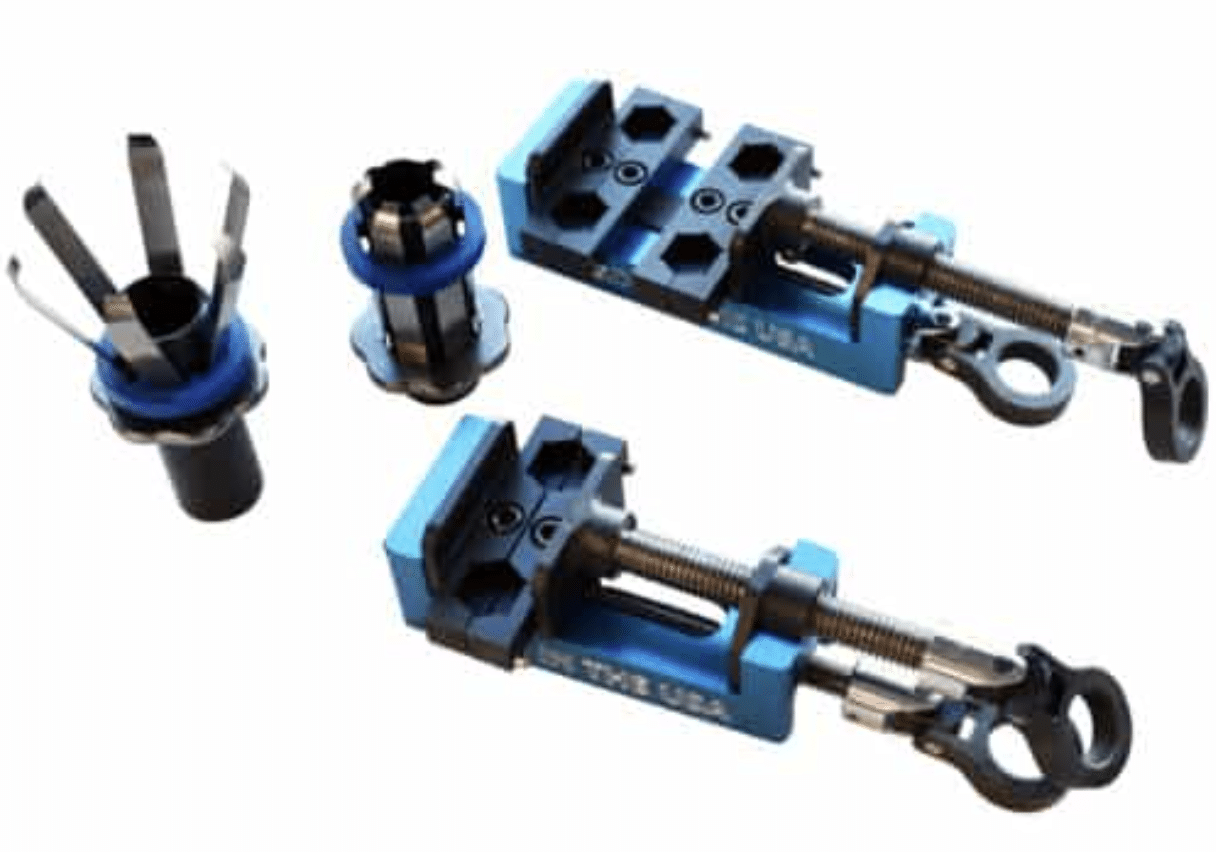
The Tri-Clamp is a patented, multi-plane clamp designed to cradle bolts securely according to NEMA spacing, then clasp to the mounting pad of a connecting jumper line. In practical terms, it helps stabilize the hardware before the connection is made, giving crews a more organized way to complete a task that can otherwise require awkward alignment, extra handling, and repeated attempts. This added bolt stability can cut connecting times by as much as 65% when moving hot jumpers.
What makes the Tri-Clamp stand out is that it is not just a holder; it is a system. The kit includes a 2-bolt clamp, a 4-bolt clamp, two Tri-Clamp Hot Sockets, and a carrying case, giving crews the core components needed to support common jumper-connection setups. The listed kit weight is 8.35 pounds, with dimensions of 4 × 16 × 12.5 inches, making it substantial enough for field use while still portable in the provided case.
The starter socket is a key part of the workflow. It is designed to hold a nut, lock washer, and washer in alignment simultaneously, allowing linemen to seat all three onto the matching bolt in one motion. That may sound like a small detail, but anyone who has worked around energized equipment knows how much time and focus can be lost when hardware slips, falls, or has to be re-stacked in the correct order. By helping eliminate dropped washers and supporting a more systematic connection process, the Tri-Clamp helps crews keep the work moving.
Safety is the larger story. DDIN designed this tool to reduce linemen’s exposure and make a hazardous task more practical and safer. The benefit comes from removing unnecessary handling steps, improving stability, and helping linemen complete connections more predictably. In field work, safer often means fewer surprises, fewer repositions, and less time spent correcting small problems in difficult conditions.
Efficiency also matters. Faster connection times can help crews work with confidence, especially during jobs where every minute of exposure matters. A tool that improves organization at the bolt, washer, and nut level can create meaningful gains across the entire task. Instead of fighting alignment, the crew can focus on proper positioning, communication, and completion.
The Tri-Clamp is especially useful because it addresses a real-world pain point without overcomplicating the solution. The concept is straightforward: stabilize the bolts, hold the hardware in sequence, and let the lineman make the connection in a cleaner, more controlled motion. For utilities, contractors, and crews that regularly handle hot jumper work, that kind of simplicity can be valuable.
It also reflects a larger trend in modern line tools: purpose-built equipment that reduces exposure while improving repeatability. Linemen do not need gimmicks in the field. They need tools that respect the job, the hazards, and the way work is actually performed. The Tri-Clamp fits that category by focusing on one specific, high-friction task and making it more manageable.
For supervisors and safety teams, the value is easy to understand. Standardizing a connection process can make training clearer and job-site expectations easier to communicate. When the same tool supports alignment, hardware control, and repeatable motion, crews gain a shared method instead of relying only on individual workarounds. That consistency can be just as important as speed.
For crews already using DDIN equipment, the Tri-Clamp belongs naturally in the accessories lineup. It is compact, kit-based, and designed around the realities of jumper connections. More importantly, it gives linemen a way to take a task known for small dropped parts and difficult alignment and turn it into a more controlled process.
When the job involves energized environments, stability is not a convenience; it is a safety and productivity advantage. The Tri-Clamp helps bring that stability to hot jumper connections, one bolt, washer, and nut at a time.