When it comes to conductor stringing, every tool on the job has a purpose. Stringing blocks guide the conductor, pulling equipment provides the force needed to move the wire, and grounding equipment helps maintain safety throughout the process. One of the most important—but often misunderstood—pieces of equipment in a stringing operation is the traveling ground.
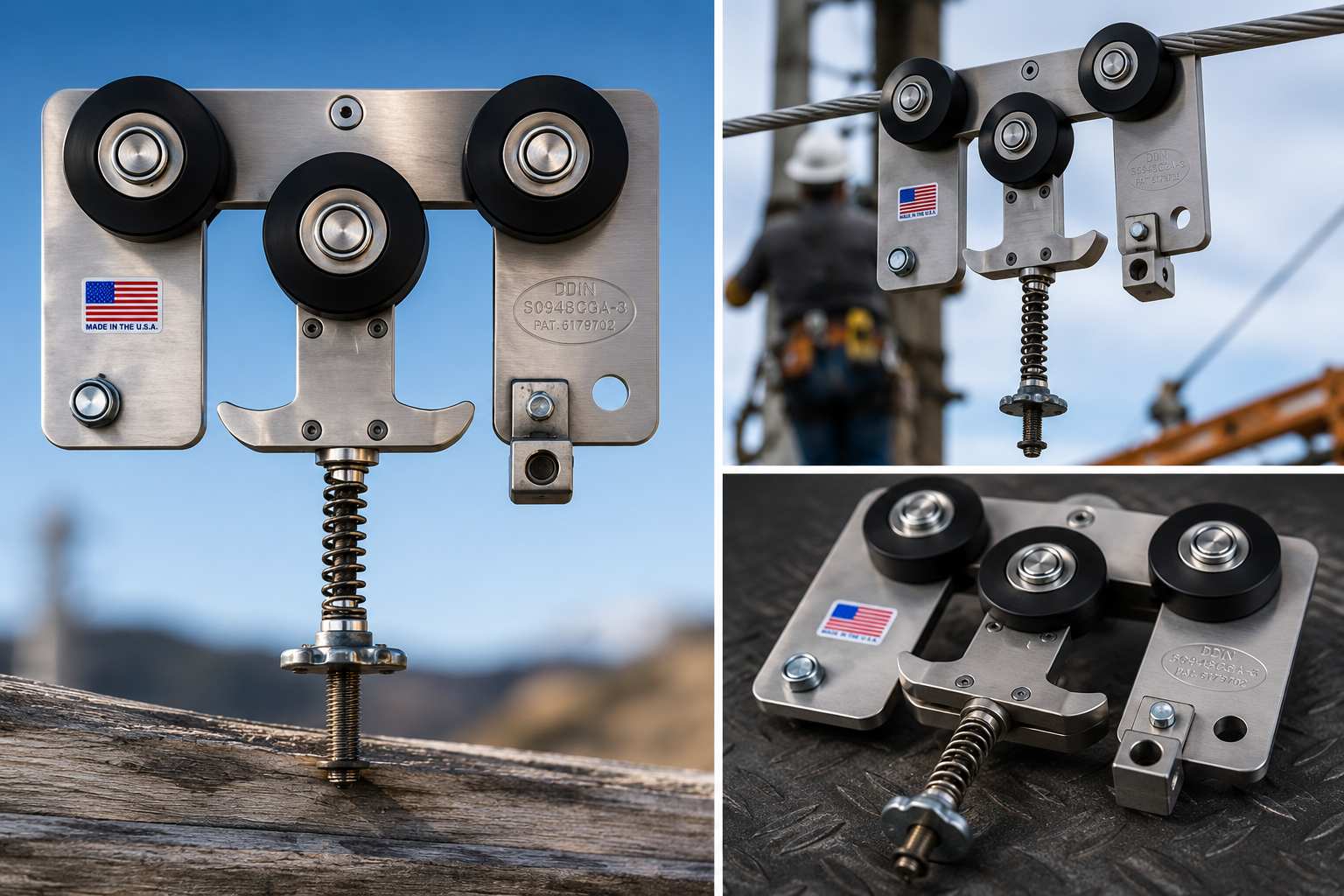
DDIN Traveling Grounds are designed to help linemen maintain a positive electrical connection between the conductor and ground throughout a conductor stringing project. By providing a reliable grounding path while still allowing the conductor to move freely through the system, these tools help crews complete demanding transmission and distribution work with confidence.
What Are Traveling Grounds?
During conductor stringing, maintaining proper grounding is critical. A traveling ground is a grounding device that stays in a relatively fixed position along the stringing line while the conductor moves through it during the pull.
Although the name “traveling ground” can be misleading, the tool itself does not continuously move down the line like a block. Instead, it remains positioned in the stringing setup while the conductor passes through its rollers. The rollers allow smooth conductor movement while maintaining constant electrical contact.
This continuous contact is essential. If the conductor were to become accidentally energized during the pull, the traveling ground provides a controlled path to redirect that energy safely into the grounding system.
In some field references and diagrams, this equipment may also be labeled as a “running ground.” In DDIN terminology, this is what we refer to as a traveling ground.
To complete the system, a dedicated ground set connects the traveling ground to a proper earth ground, ensuring any unexpected electrical discharge is safely carried away from personnel and equipment.
Traveling Grounds vs. Stringing Blocks
It is also important to distinguish between traveling grounds and stringing blocks, as the two are sometimes confused in field diagrams.
- Stringing blocks (or “payoff pulleys”) guide and support the conductor as it is pulled from reel stands through the line route.
- Traveling grounds (sometimes labeled “grounding pulleys” or “running grounds”) maintain electrical grounding while allowing the conductor to pass through.
In some technical illustrations, such as those found in research on transmission line construction and tensioning systems, these terms may be labeled inconsistently. However, the functional difference remains the same: stringing blocks guide the conductor, while traveling grounds protect the system electrically during movement.
Built for Distribution and Transmission Applications
Not every conductor stringing project has the same requirements. The conductor size, application, and job conditions all determine what equipment is needed.
DDIN Standard Traveling Grounds are available for both distribution and transmission applications. These models feature a reversible ground stud designed to accommodate most ground clamps and an adjustable spring-loaded center roller that maintains consistent pressure on the conductor.
Transmission applications often require equipment capable of handling larger conductors and heavier-duty pulls. DDIN transmission traveling grounds are designed with larger roller sizes and conductor capacities suited for these demanding environments. For example, the Aluminum Standard Traveling Grounds, Transmission model features a 3-inch roller, aluminum roller construction, and cable capacity from 3/4 inch to 2 inches.
T2® VR2® Traveling Grounds
Modern transmission projects continue to push the limits of conductor size and pulling requirements. DDIN’s T2® VR2® Traveling Grounds are engineered specifically for T2® wire applications.
These traveling grounds feature a reversible ground stud, adjustable spring-loaded center roller, and a design focused on maintaining consistent conductor contact throughout the pull. Available models support T2® conductor ranges including 4/0–556 and 795–1113 applications.
For crews working on large reconductoring or transmission builds, using equipment designed specifically for the conductor type improves both efficiency and reliability in the field.
Torsion Spring Traveling Grounds
Some jobs require additional flexibility, especially when dealing with splices and swivels during conductor pulls. DDIN’s Torsion Spring Traveling Grounds are designed with a torsion spring system that allows splices and swivels to pass through the rollers without interrupting operation.
The design includes two adjustment positions to help crews set the ideal tension on the conductor. It also uses oil-impregnated bronze bushings to support smooth operation and long-term durability. The torsion spring model is designed for transmission applications with conductor capacities from approximately 1.040 inches (795 kcmil) through 2-1/2 inches and weighs approximately 18 pounds.
Why Quality Traveling Grounds Matter
A conductor pull is a coordinated effort involving multiple pieces of equipment and multiple members of the crew. A failure or inefficiency in one area can slow the entire operation.
Reliable traveling grounds help crews maintain consistent grounding throughout the pull while reducing the need for unnecessary adjustments. Features like adjustable rollers, durable materials, and application-specific designs allow linemen to focus on the work instead of fighting their equipment.
The best lineman tools are not simply tools that complete a task—they are tools that make the job safer, smoother, and more predictable.
Choosing the Right Traveling Ground
Selecting the correct traveling ground starts with understanding the job requirements:
- What type of conductor is being installed?
- Is the project distribution or transmission?
- What conductor size range is required?
- Does the application require additional flexibility for splices or swivels?
- Is aluminum or steel roller construction preferred?
DDIN provides multiple traveling ground solutions to meet these different needs, giving crews options for a wide range of stringing applications.
Traveling grounds may not always be the first tool people think about when preparing for a conductor stringing project, but they play an essential role in successful operations. The right traveling ground provides reliable grounding, smooth conductor movement, and confidence that the equipment is ready for the demands of the job.
For linemen working in distribution and transmission environments, investing in quality equipment is not just about productivity—it is about creating a safer and more efficient work environment.
DDIN Traveling Grounds are built with the jobsite in mind, giving crews dependable solutions for some of the most demanding work in the electrical industry